
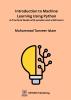
Introduction to Machine Learning Using Python: A Practical Guide with pandas and scikit-learn
Keywords:
machine learning; Python; scikit-learn; pandas; matplotlib; supervised learning; unsupervised learning; classification; regression; model evaluation; cross validation; data preprocessing; imbalanced data; feature engineeringSynopsis
Nowadays, Machine Learning helps develop decision-support systems across various real-world fields, including engineering, healthcare, finance, and public policy. Many new learners still struggle to understand the relationship between machine learning theory and working code, which this book addresses. This book provides the core concepts of machine learning and shows, step by step, how to implement the ideas using Python. At the start of the book, it covers the fundamental components of machine learning, including data preparation, exploration, splitting, pre-processing, and visualization. Then the book covers the concepts and implementations of supervised learning algorithms, including linear and logistic regression, k-nearest neighbors, decision trees, support vector machines, and ensemble methods such as random forests and gradient boosting. Next, the book works with unsupervised learning, including clustering and dimensionality reduction. A full chapter explores important topics such as model evaluation, cross-validation, and hyperparameter tuning, with clear guidance on avoiding data leakage. Later chapters address practical problems that real datasets bring, such as class imbalance and handling missing values. Every chapter includes brief explanations of the mathematics, complete Python code using NumPy, pandas, matplotlib, and scikit-learn, and exercises with real datasets. The book is useful for undergraduate and graduate students, researchers, and practitioners seeking a robust and honest starting point in machine learning.
Downloads
Download data is not yet available.
References
Forthcoming
December 31, 2026
Categories
Copyright (c) 2026 Muhammad Tanveer Islam (Author)

How to Cite
Islam, M. T. (2026). Introduction to Machine Learning Using Python: A Practical Guide with pandas and scikit-learn. Spider Publishing Books. https://doi.org/10.66348/spider.books.v1.010.26


 SPIDER Publishing, Bangladesh
 Polashpole, Kamalnagar, Satkhira Sadar, Satkhira-9400, Bangladesh
 admin@spiderpublishing.com
